

A Note from Your Chief Wellness Officer:
My relationship with food is not one I have spent a lot of time thinking about. When you grow up in a Haitian home, you eat what is placed in front of you. In hindsight, I am so grateful for these delicious, varied and balanced meals because I grew up in Miami in the 90s. Pretty much anywhere in the US in the 90s was full of mega food marketing, even to children. My mother always recounts this anecdote that when I was barely old enough to read, I could already recognize the golden arches of a McDonald’s from the advertising I would see. “McDonalds!” I would yell from our driving car.
Fast-forward to my early adulthood, when I moved to New York for my first job out of undergrad. I was living in the West Village with a roommate and a tiny fridge. I was very cash-conscious and I remember making a list of my groceries and comparing the prices between a regular grocery store, Whole Foods and Trader Joe’s. Trader Joe’s won by far. I strategized my meals to account for all the late nights I was spending at the office. And that’s how I eventually learned, after eating a can of Trader Joe’s black bean soup, that my nickel allergy my mother always warned me about for my earring choices had evolved to full-blown food allergy. Anytime I would forget and eat canned ingredients (tomato sauce on a 99-cent pizza slice, tuna from a picnic salad, coconut milk from a Thai curry takeout…you get the drift) my face and neck would break out in a full-on dermatitis rash. So I began (out of pure obligation) to get hyper-mindful about the sources of all the ingredients in my food and I started cooking more fresh ingredients. And I am so thankful for this wakeup call that “you are (essentially) what you eat.”
By the time I moved from New York to Paris in 2021, I was in my full-on organically-sourced, “food as medicine” worldview. France in general has a special relationship with food and moving to France has made me very aware of how different the food marketing landscape is. Fresh food markets are a weekly occurrence in almost every Parisian neighborhood and food advertising always comes with a small warning caption that you should prioritize a balanced and healthy diet. But this doesn’t mean that all my food choices miraculously became healthy ones. Especially in a corporate setting with travel, work events and busy days…food choices can be hard. And it is in this context that I met Julia.
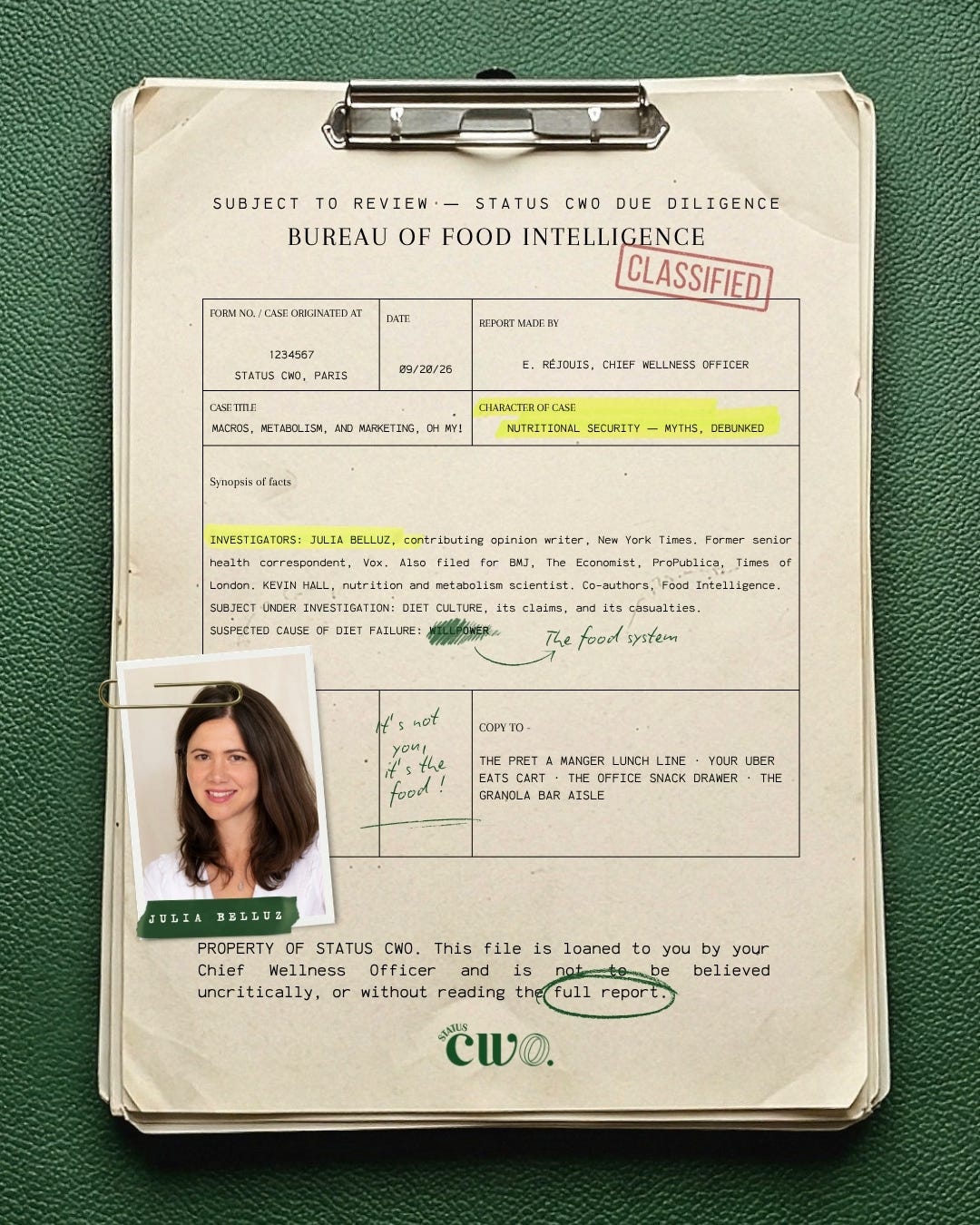
Julia Belluz is a Paris-based journalist and contributing opinion writer at the New York Times, where her reporting spans medicine, nutrition, and global public health. Beyond spending years as Vox’s senior health correspondent, Julia has also written for the BMJ (a peer-reviewed medical journal), the Economist, ProPublica, and the Times of London.
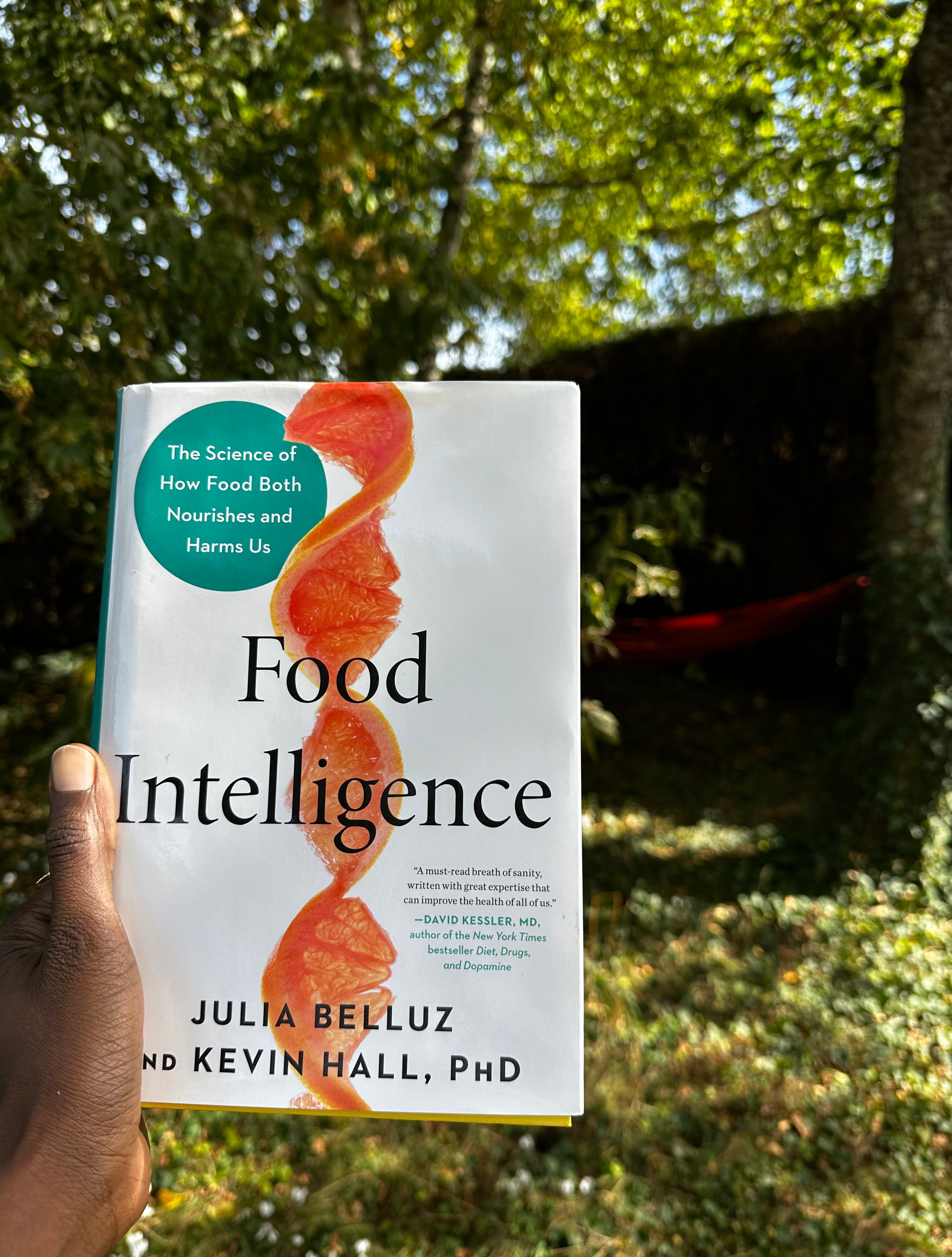
Her latest book, Food Intelligence, co-authored with renowned nutrition and metabolism scientist Kevin Hall, tackles decades of diet mythology to explain what we actually know (and don’t) about food, weight, and the systems designed to shape both.
What compelled you to write a book about food intelligence?
I had struggled with my weight, and tried every fad diet you can imagine during my teens and 20s. I always felt like my failure to lose weight then was a failure of will power, which was confusing because in many other domains of my life, it seemed I had limitless will power.
When I started to write about chronic, diet-caused diseases like obesity and diabetes, I realized I was not alone. So many people were struggling with food. And when I started to look into what was causing the surges in obesity, diabetes, and other diet-caused diseases in America and around the world, it became clear that individual failures of will power had nothing to do with it.
What changed in the time these diseases became widespread was the corporate takeover of the food environment. Calorie-dense, hyper-palatable, ultra-processed foods became ubiquitous, and replaced whole foods in our diets. These foods disrupt our ability to regulate our appetite, and drive the craving and overeating that eventually leads to diet-caused diseases.
I wanted to unpack how all of this happens, and shine a light on how the modern food environment transformed in ways that heavily disrupt our innate nutritional wisdom, our food intelligence!
What's the one piece of nutrition advice you'd want every busy professional woman to unlearn immediately?
There are so many! But I guess what I’m most skeptical of are the ultra-specific bits of supposed “wisdom” and diet hacks that fill social media – eat more of this superfood, combine these foods for longevity or perimenopause, etc. Because nutrition and food are so mind-bogglingly complex, it’s really hard to design studies about how a particular food or even diet impacts long-term health or one health end point. And while we know a lot about the minimum nutrition requirements for survival, we know very little about optimizing nutrition for trending topics like perimenopause or longevity.
That means we simply don’t have good research to back many of the super specific claims influencers make. I also worry this advice confuses people and distracts from what we know matters for our health. That is a dietary pattern that features lots of minimally processed foods — vegetables, fruits and legumes, whole grains, fiber — and minimizes unhealthy ultra-processed foods, while also limiting sugar, sodium, and saturated fat.
Your argument is that this isn’t about willpower but that it’s the food system working as intended. What does that actually mean for someone standing in a Pret A Manger or ordering an Uber Eats at 1pm between two meetings?
Keep it very simple! Choose the most minimally processed, nutritious option you like. So the hard-boiled eggs and salad, instead of the ultra-processed pizza-pocket thing. Have the fruit for dessert instead of the pudding. Drink water with your meal, not sugary soda.
Like this article? Share it with someone you think would enjoy it as well.
If someone has five minutes to make a food decision and zero mental bandwidth left due to decision fatigue, what's the one question they should ask themselves?
Is this a meal that’s going to make me feel good, and satisfied, or is it just going to drive craving and cause me to want to eat more? Choose the meal that will do the former.
What’s a “healthy” food or habit that’s actually just marketing, and what should replace it in a busy woman’s mental shortlist?
A lot of supposedly healthy granola bars are thinly disguised junk, filled with sugar, calories and other additives. The same goes for many commercial smoothies, detox juices and meal-replacement drinks.
I’d replace all of these with fresh, whole food wherever possible. Yogurt with fruit, seeds, and a little honey in the morning instead of the granola bar. Instead of a detox drink or smoothie, eat some chopped vegetables, fruit and nuts for your snack.
Researching this book made me think more about the structure of the foods I eat and feed my kids. Intact, whole foods are nutritious not just because of the vitamins and other nutrients they deliver but because they have fibrous structures that nourish our digestive systems in ways that heavily processed — sometimes called “pre-digested” foods — can’t and don’t.
Your past reporting has addressed how food companies design products to be irresistible. Do you see a parallel with how today’s work environments override our own signals for “rest and digest”?
Oh totally! I think about the modern food environment as just one of the places where we are pushed to ignore our body’s signals, or the signals become so warped they start to work against us. Smartphones and social media are another such space. How many times have you laid in bed, totally exhausted, your body desperately in need of sleep, but you can’t stop scrolling?
If someone reads your book and takes away just one belief shift, what would you want that shift to be?
Many of our food choices we make happen below the level of conscious awareness, so you need to do your best to redesign your individual food environment so that the healthy choice is the easy choice. That might mean keeping the foods that cause craving out of the house and office, or if you do have some, keeping them far away from the kitchen and your desk. Feature the healthy choices more prominently – so the bowl of fruit on the kitchen counter. Also: Don’t be so hard on yourself. We now live in food environments that are entirely rigged against us making the best choices for our health. It is hard work fighting against that toxic environment and many people struggle. In a few words: it’s not you, it’s the food.
Once mastered, what would "food intelligence" look like for the woman who travels for work, is forced to skip a proper lunch to stay on client calls, and eats dinner late on average three nights a week?
This is a situation many women face, and a real challenge but not impossible to overcome. It requires thinking about how to create the healthiest food environment you can, given the limitations you have. Maybe it means packing meals and snacks everyday, or if you can, hiring someone to do that work for you, and then planning small breaks to simply eat before you’re famished. Maybe it means doing the late dinner once a week, instead of three times a week, and changing the other dinners to walking meetings or a glass of wine. Maybe it also means lobbying in your workplace to shift the culture so that it’s not impossible to do the basic act of feeding yourself nourishing meals.
What's something you personally no longer worry about food-wise now that you've spent years inside this research?
I try not to obsess too much over the small details. So the cake I ate on the weekend, or the extra serving of pizza I had at the office party. What matters most for health isn’t the single food, or meal, but our overall eating pattern. And if I’m generally eating in a way that reflects the boring but sound diet advice — lots of fruit, vegetables and legumes, not so much sugar, salt, and saturated fat, limited ultra-processed foods— I’m not going to stress!
For more from Julia: see her substack and the Food Intelligence book, co-authored with Kevin Hall.
Thanks for reading Status CWO. If you like the content, please do share!
Fab interview - immediately ordered a copy of Julia's book! As someone studying to become a nutritionist I've found myself spending a lot of time thinking about how our environment impacts our choices and why - even when you know what's 'healthy' and what's not - it's hard to make nutritious choices 100% of the time. Really enjoyed this and look forward to seeing more from Status CWO!